
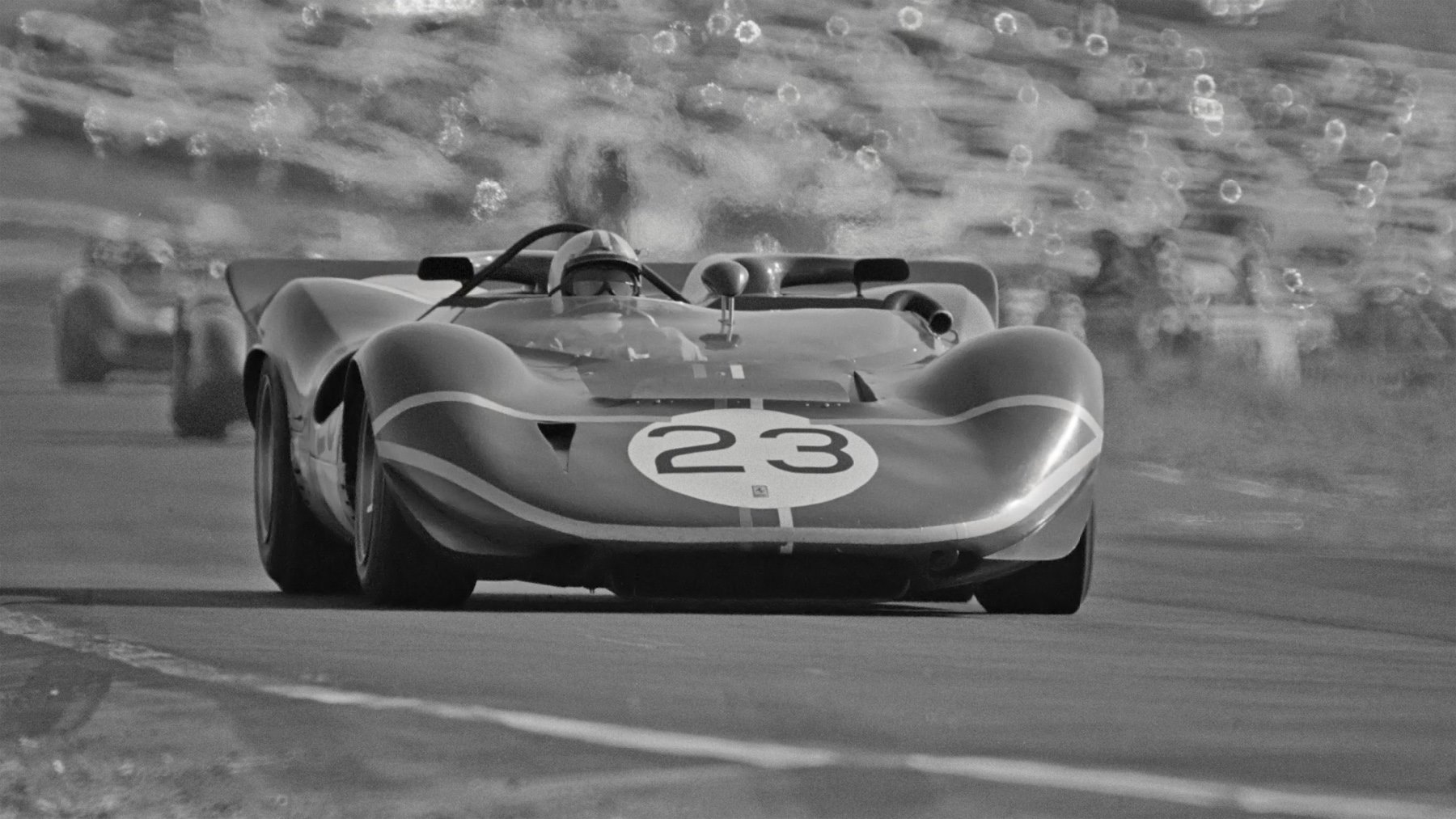
In racing, the dark post-War days were long gone and many new concepts were emerging: Europeans were still following the path of smaller engine while Americans kept true to their big ones, the only difference being that now they were stuffing them in small, lightweight, cars from across the pond. Shelby’s work on the British-built AC Ace was one of the first success stories and this fashion started to propagate as big engines were now finding their ways in purpose-built European sports-prototypes.
The United States Road Racing Championship came as a natural answer to the increasing numbers of such hybrid machines, like the Cooper Monaco or the Lotus 23B which sported powerful V8s. Its popularity pushed the Sports Car Club of America (SCCA) to make another step: create the Canadian-American Challenge Cup which was to be the meeting place for these purpose-built prototypes.

The premises smelled of success from the get-go: there were barely any rules put in place for these state-of-the-art “Group 7” cars and, on top of that, the prize money was huge. So big that it attracted most of Europe’s Formula 1 stars that came to America to win the sort of money that you would never get in F1 – not even if you were to win the World Championship.
Bemused, Americans watched as Europeans flooded in their new series and stole the show not by employing their smaller capacity engine, but by carefully preparing cars that followed the American’s own ethos. Such a car was Eric Broadley’s Lola T70. The car, which debuted in 1965, won the inaugural Can-Am championship in 1966 with a factory-backed effort spearheaded by 1964 F1 World Champion John Surtees. The ensuing years followed the same story line, only that in Lola’s place came the McLaren squad with their orange machines and immaculate preparation. They won the series a record five times and only turbo power from Zuffenhausen trashed the Mclaren party.
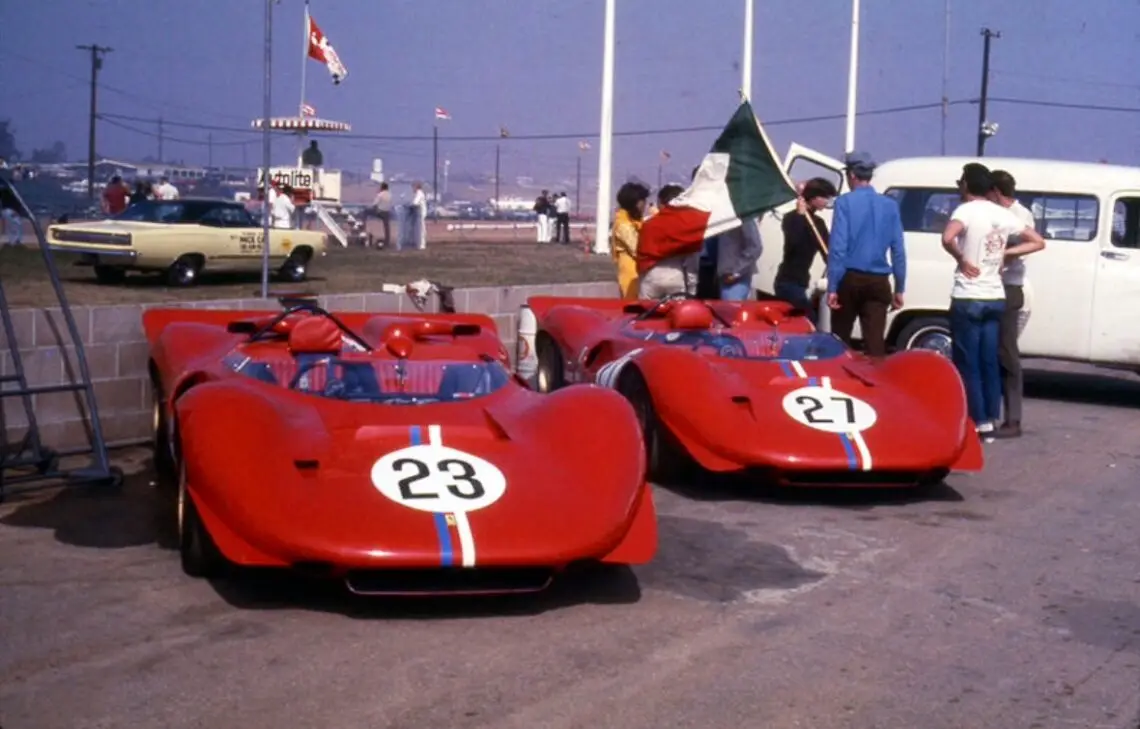
By this point you might be wondering what’s with the title as I haven’t even mentioned the Prancing Horse even once. That’s because The Drake never really took the Can-Am serious but the money and Luigi Chinetti’s instrumental push meant that the red beasts did not miss the series which was, in it’s heyday, the peak of sports car racing.
1966 saw no Ferraris on the grid although some outdated Dino 206s spyders did run in the USRRC. The factory decided to wait and see how it all pans out as the Italian’s reckoned the championship will be short lived. As it proved to be quite the opposite, Ferrari stepped in half-way through 1967.
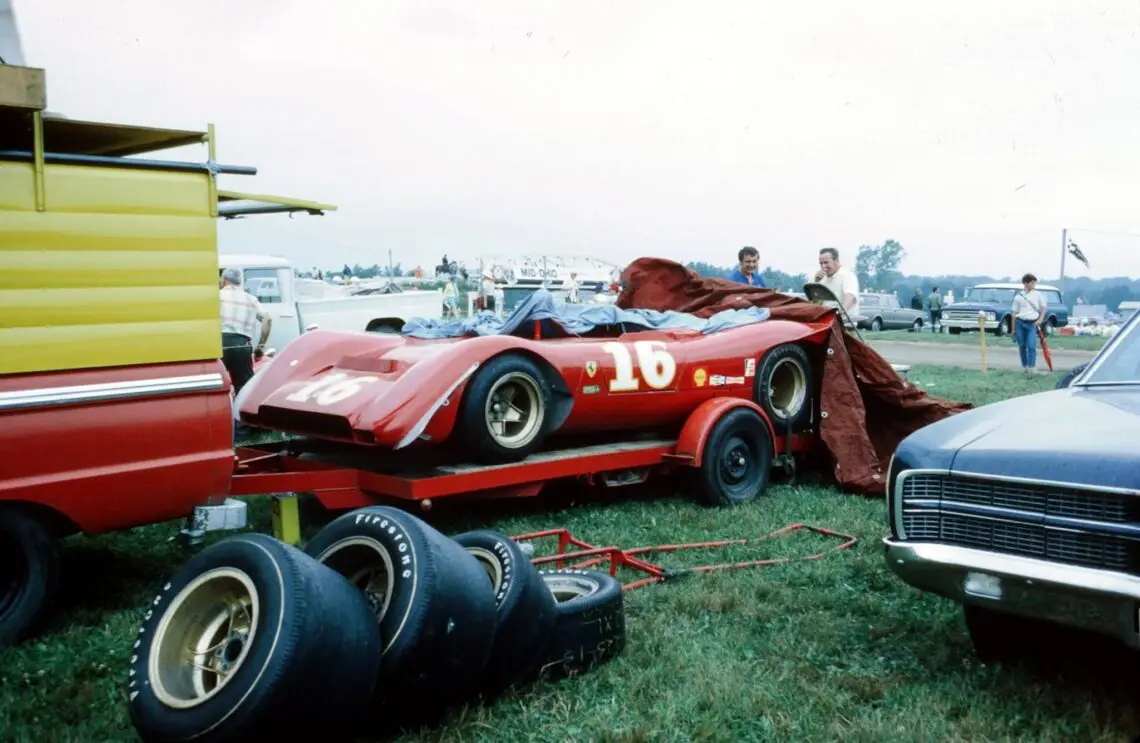
The initial foray was half-hearted but the re-bodied 330 P4 looked gorgeous. Since Ferrari only equipped their sports cars with engines that were similar to those on their road cars, Enzo viewing the technology transfer from race track to the road as a key to the company’s success, the 330 P3 had a minuscule powerplant compared to the seven-liter-worth of American grunt that powered the McLarens. It was, nonetheless, a V12 so the enchanting soundtrack was there. Sadly, the performance was not.
For the first part of 1967, Ferrari was represented by Chinetti’s North American Racing Team (N.A.R.T.) which ran the 242-c.i. four overhead cam V12-powered P3. The debut took place at Bridgehampton where the car’s lack of both torque and horsepower were somewhat hidden by Ludovico Scarfiotti’s driving who, helped by attrition, came home a respectable 7th. At Mosport, the third round of the season, Scarfiotti ran well despite an early pit-stop until he crashed following a puncture. This retirement marked the end of N.A.R.T.’s entry as a full-fledged Ferrari effort took its place after that.
Bill Harrah’s Modern Motors operation made Ferrari’s presence possible, the two factory cars being based on the current endurance racer, the 330 P4. This meant improved performance, the power figure being in the region of 485 hp. Chris Amon, Ferrari’s no. 1 F1 driver, and Jonathan Williams handled driving duties for the first outing at Laguna Seca where the Scuderia’s master chief engineer Mauro Forgheri was on the pit wall. The cars ran around without a hitch, Amon finishing fifth and Williams eight – not too bad considering that the cars still lacked the all-too-important mid-range torque of the American V8s.
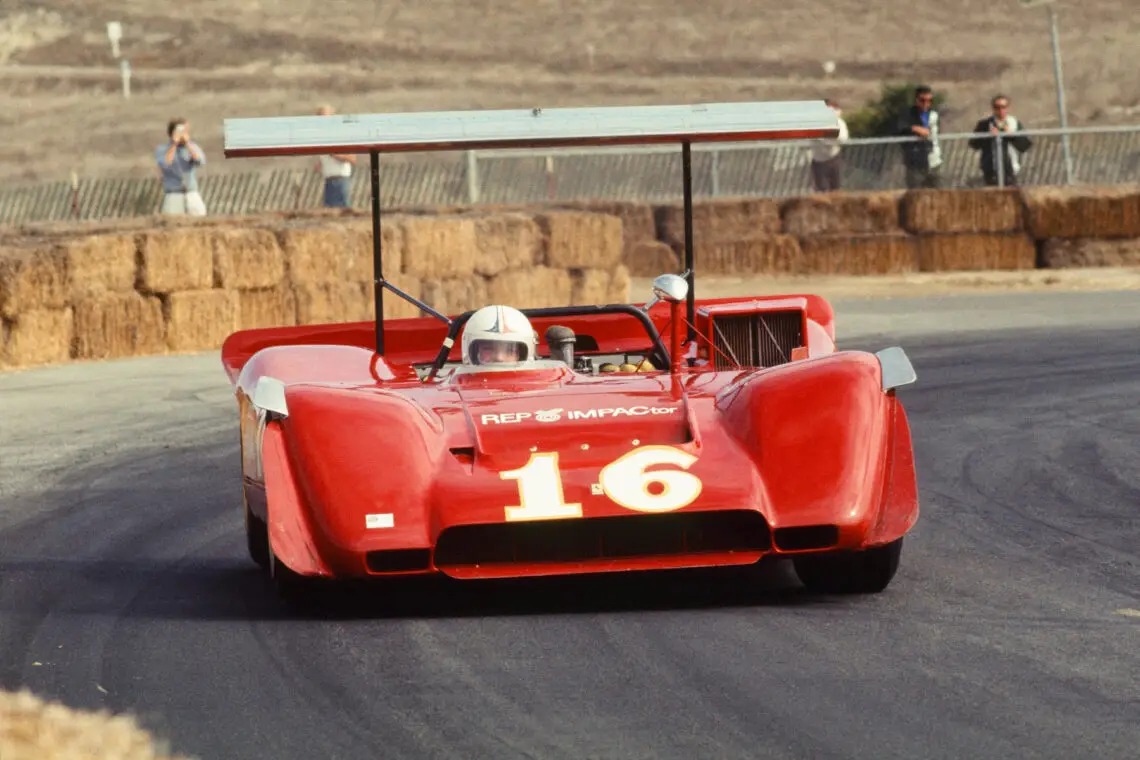
What they did not lack was reliability as the V12s were originally conceived for endurance racing, whereas the Chevy or Ford motors were set up for sprints and routinely expired forcing teams to go through multiple engines during a single race weekend. This was an unheard-of practice at Ferrari who soldiered on for multiple races with the same engine. The following two rounds proved troublesome for the Ferraris: at Riverside the cars seemed lackluster, completely outperformed by the McLarens and Lolas as Amon finished 8th while at Las Vegas Williams didn’t even make it past turn one with Amon crashing out in the final stages and missing on a rather big amount of prize money.
In the off-season, Ferrari’s work concentrated on building a high displacement engine which was already long in the tooth given the opposition’s strength. This meant that most of 1968 rolled by without a single Ferrari on the grid. Only at Road America did one red machine pop up under the N.A.R.T. banner for the ultra-quick Pedro Rodriguez. Sadly the car was not up to the driver’s abilities and Pedro could do no better than 13th in the 4.2-liter 350P4. Finally, Ferrari showed up with a brand-new car for the final race of the season: the Las Vegas GP at the dead-flat Stardust Raceway which is now nothing but a memory.

Christened the 612P, Ferrari’s new Group 7 car boosted a 350-c.i. V12 engine which gave 620 horsepower at 7.000 rpm. The wedge-shaped car also benefitted from a Formula 1-inspired rear wing, its hydraulic system adding to the car’s weight which meant it was quite a handful to drive. As it happened, the 612 never made it past turn 1 as multiple cars went off throwing dust in the air which, in turn, choked the Lucas injection system. Ferrari’s star was dusted out of the race at Stardust one may say…
The following year, Ferrari was unable to shake the establishment – although the 612P received a high wing similar to those on the Chaparal and McLaren. There was also another Ferrari that made its way to the grid as a one-time-only deal. It was a close-cockpit 312P which ran at Bridgehampton. The gorgeous car which would be seen in Europe in open-cockpit specification finished fifth, Pedro Rodriguez again incapable of fighting with the leaders. Going back to the 612, it first run at Watkins Glen with a simpler and lighter body and with 40 more horsepower. The car muscled its way to 3rd place, another podium finish following at Edmonton where Denny Hulme noted, “that Chrissy guy is a determined little bugger, isn’t he?” A third podium at Mid-Ohio pretty much answered Denny’s question. Then on, a series of problems sidelined the effort, chief among which being the inadequate flow capacity of the oil radiators which was causing the oil pumps to stall which, in turn, cogged the drive belt. The result? Bearing failure.

Not much happened on the Ferrari front during the 1970 season, although Jim Adams did show up with a 512S a bunch of times, returning in 1971 with a heavily modified 612P which proved a failure. That year, the factory returned with the biggest, baddest Group 7 Ferrari ever: the behemoth 712P. The car was, originally, Adams’ 512S (chassis #1010) which was re-bodied and given a 7-liter engine. After its debut at Watkins Glen it ran intermittently with little success, mostly owing to under-development, until 1974 when it bowed out of competition after one final showing at Watkins Glen where Brian Redman brought it as high as 2nd but did not finish. Of note is also the involvement of well-known Swiss privateer Herbert Muller who pressured on with his open-top 512Ms well into the final years of the series despite being just an also-ran most of the time.
Looking back on it all, the Ferrari 712’s story best embodies that of the Scuderia’s involvement in this series: sometimes proving strong but insufficient funding and development meant that the red barchetta’s were never a threat – they just added a taste of Italy to Can-Am’s tasty salad which is, to this day, one of the tastiest ever in motorsport’s history.